



Executive Presence Is Mostly B*****ks
Submitted by Jack Milner on August 14, 2026
When I first started working in communication skills about 25 years ago, imposter syndrome was running rampant in my head.
An HR Director would say, “We’ve got some brilliant senior leaders, but we need them to have more executive presence.”
And I’d nod knowingly, despite the fact that I had absolutely no idea what executive presence was. In those days, I wasn’t entirely sure what an executive was.
One of my first jobs was with an investment bank. A senior leader had found a leaflet advertising my stand-up comedy workshops and asked me to work with about 50 analysts. They wanted them to be less boring, more impactful and, yes, to have more “executive presence”.
About an hour into my first workshop, a man in the front row put his hand up.
“This executive presence stuff is bollocks.”
And walked out.
Everyone was terribly sympathetic. Someone shouted from the back, “Don’t worry. He’s an arsehole.”
About a year later, I woke up and thought: Damn. The arsehole was right.
Because executive presence, as it’s often taught, is about looking confident. Stand tall. Speak slowly. Make eye contact. Use your hands. Land your KPIs. Wander around like a Master of the Universe.
That’s not executive presence. That’s executive how-to-be-a-twat.
And ironically, I now think the word executive gives us a clue as to what’s going wrong.
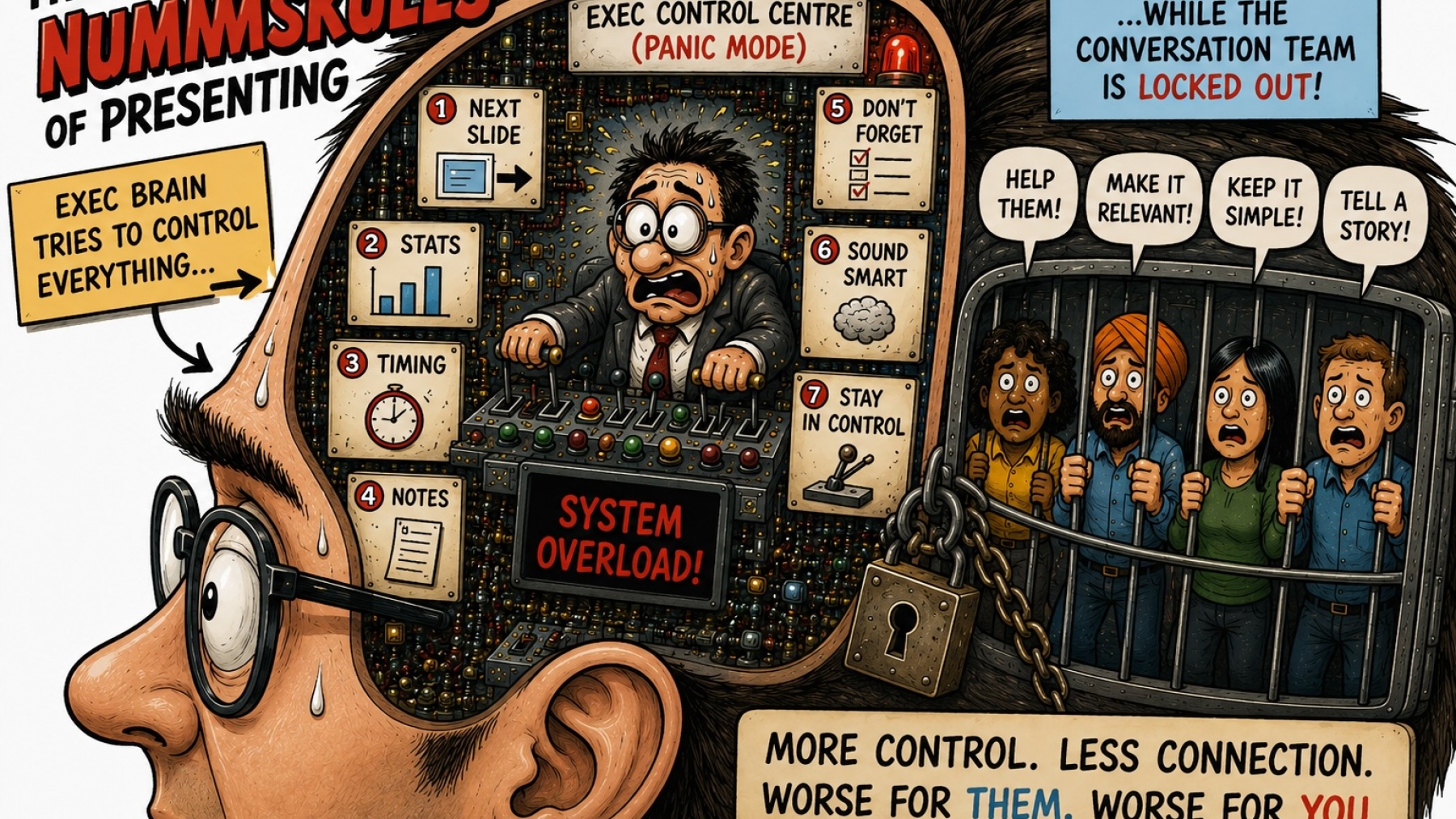
When we present, we tend to put the executive part of our brain in charge. Our prefrontal cortex is heavily involved in planning, attention and working memory. All very useful. But then we ask the poor thing to do everything.
Remember the next slide. Remember the statistic. Make eye contact. Slow down. Don’t say “um”. Look confident.
Then add some pressure.
Working memory has limited capacity, and anxiety and self-monitoring give it even more to deal with. Suddenly, there’s one panicky executive pulling 17 levers while a couple of librarians desperately search through filing cabinets shouting:
“WHERE’S THAT BLOODY STATISTIC?”
This is why I think we’ve got presentation training the wrong way round.
Don’t present. Explain.
You’ve spent relatively little of your life presenting. You’ve spent your entire life explaining things to people.
When you explain, you’re not thinking about your hands, your pauses or bullet point three. You’re thinking: Do they understand this? How can I make it clearer? What do they need to know?
Your attention moves from you to them.
And that's connection.
Last week I worked with a woman who told me she'd suffered terrible shakes while presenting for 20 years. What she particularly hated was being interrupted or people going off on tangents.
I asked her to present without her notes.
“You know your topic. You’re the expert. Just talk to us. Explain it.”
For three minutes she was clear, concise and confident. She told a story, got a couple of laughs, created genuine emotional connection and finished with three cracking takeaways.
Then she looked down at her hands.
“Oh wow. I’m not shaking.”
She told us it was the first time in 20 years she hadn't shaken while presenting.
Now, that’s one person’s experience, not a scientific study. But I’ve seen variations of it again and again.
So, three things to try:
1. Don’t present. Explain.
Know your subject, then explain it to the human beings in front of you. Your job isn't to remember a presentation. It's to help them understand.
2. Look for connection from the first second.
Instead of “What do I need to say?”, think “Who am I talking to?”
3. Tell a story.
It’s a cheeky shortcut into conversational mode. You're not retrieving bullet points. You're simply telling somebody what happened.
Perhaps that's what real executive presence is.
Not making yourself look important.
Making the people you're talking to feel important.