



What Procurement Taught me About Play
Submitted by Jack Milner on September 16, 2026
Last week I was running some online presentation training for an American health insurance procurement team. And as you’re reading that, I can imagine your thoughts are: Well, that must have been fun.
Actually, take away your preconceptions, because it really was a lot of fun. I’ve worked with this particular organisation for a few years now and, despite the label that sometimes comes with procurement, they are genuinely really nice, lovely people.
Anyway, the story.
One of the things we’d been emphasising was connection: being yourself, talking to us rather than presenting at us, and generally using more of your brain rather than overthinking every word.
For the final exercise, I divided the ten people into four teams and gave them 30 minutes to create a five-minute presentation on how to have better meetings.
Not easy.
They had to land at least three key ideas, include a story, use a prop and make it fun.
Quite genuinely, I was blown away.
All four presentations were superb. But it was the creativity, impact and clarity that staggered me. How do you go from zero to that in 30 minutes?
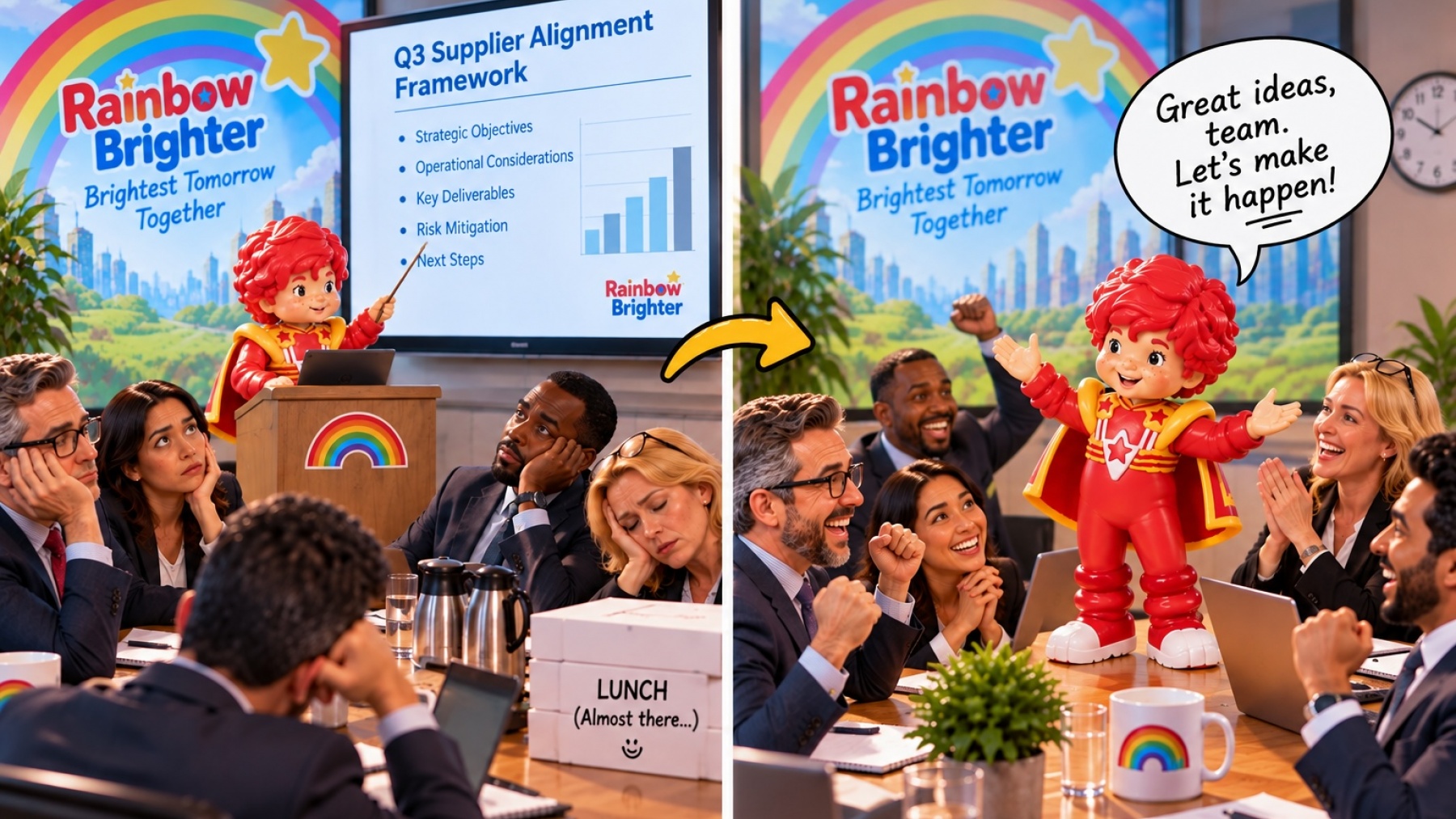
And these weren't normal presentations. One team acted out a disastrous online meeting, complete with an extraordinary special effect that made it look as though someone's camera had been splattered. Another created a genuinely funny sketch featuring an employee, their manager – and the manager's brain, saying what they were really thinking. Another somehow built their whole presentation around Red Butler, from 80s cartoon “Rainbow Brite”, role playing what happened when his meeting went horribly wrong.
Funny, clever, incredibly clear – and all created in 30 minutes.
I reflected on it afterwards and realised something.
They were playing.
It didn’t feel like work.
And that, I think, is critical.
Daniel Pink talks in Drive about the fascinating relationship between intrinsic motivation and creativity. Research with artists has found that work created for intrinsic reasons – interest, enjoyment, the pleasure of doing it – tends to be judged as more creative than work produced primarily for external rewards.
That’s pretty much what I saw.
These procurement professionals weren’t presenting about procurement. They were talking about meetings. There was freedom to muck about, try things, laugh, take risks and see what happened.
And the quality went through the roof.
So how do we bring some of that into our own communication?
Firstly, particularly at the beginning of the creative process, put the businessy goal on the back burner. Take away that noise in your head saying, This is important. This has to be brilliant.
Secondly, play. Have fun with it. Try the stupid idea. Mess around. See where it takes you. I was talking recently to my friend Andrew Doyle about the importance of play, and it’s something I increasingly think we massively underestimate at work.
And thirdly, create safety.
You can’t really play if somewhere in the back of your mind you’re thinking, This could all go up shit creek.
There still needs to be a challenge. Pink talks about the Goldilocks idea: not so difficult that we panic, not so easy that we’re bored. Just difficult enough to stretch us.
That’s exactly what happened here. Thirty minutes to create a five-minute presentation was a real challenge. But they felt safe, supported each other and had a great group vibe.
So next time you’re putting together that critically important pitch or massively important conference presentation, try dialling back – at least during the creative stage – the feeling that WE HAVE TO BE AMAZING.
Replace it with:
Let’s play. Let’s have some fun. Let’s see what we come up with.
You may be amazed at the results.